
Implementing Effective Data Governance with SemanticFed
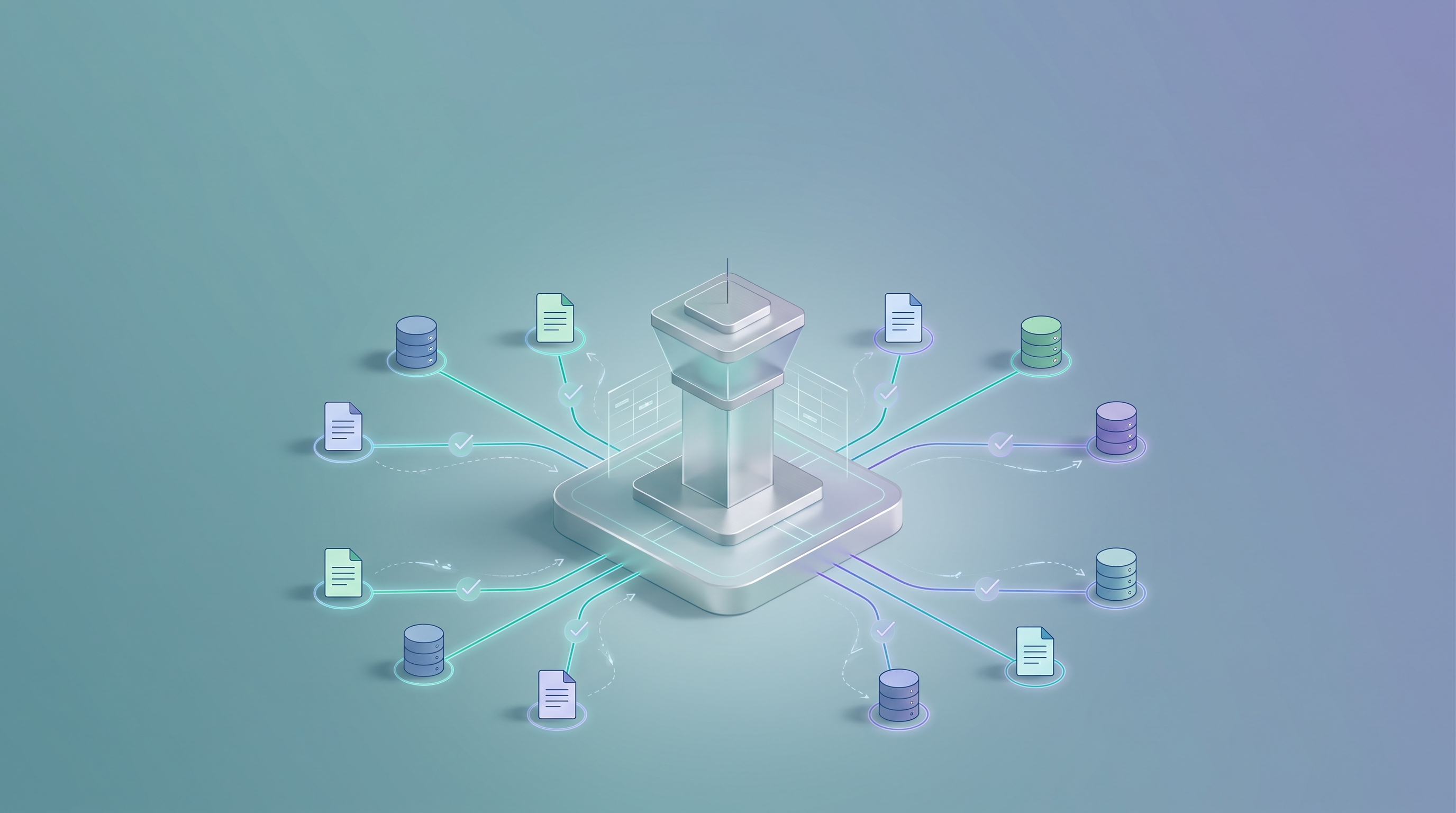
Data governance works when policy is enforced automatically, in one place, instead of chased down across a dozen systems by hand. SemanticFed is built to make that possible by putting governance directly into the query layer that already sits between your data and everyone who uses it.
What Is Data Governance, and Why Is It Hard?
Data governance is the set of rules, processes, and controls that decide who can see what data, how it can be used, and how you can prove that later if someone asks. Done well, it means a compliance officer can answer "who accessed this record" without a week of digging, and an analyst can trust that a metric labeled "revenue" means the same thing in every report it appears in.
It gets hard for a simple reason: data doesn't stay in one place. A typical organization has data spread across an operational database, a cloud warehouse, object storage, and a handful of SaaS tools, and each one tends to have its own login system, its own permission model, and its own idea of who's allowed to see what. A recent global benchmark from the EDM Association found that only around 31% of organizations have reached an advanced level of data strategy capability, meaning most are still working without the consistency and enterprise-wide alignment that real governance depends on. Governance built one source at a time tends to drift. Governance built into a shared query layer doesn't have that problem, because there's only one place for the rules to live.
How SemanticFed Approaches Governance
SemanticFed is a data federation platform: it connects to your databases, warehouses, lakes, and APIs as sources, lets you model them once in a governed semantic layer, and runs queries across all of them without copying the data anywhere. Governance isn't a separate module bolted on top of that — it's enforced at the query edge, the point where every federated query actually runs, regardless of which source the underlying rows come from.
That has a specific practical benefit: a policy defined once in SemanticFed applies to a Postgres table, a Snowflake fact table, and an S3 Parquet file identically, without you having to configure row-level security three different ways in three different systems.
The Semantic Layer's Role in Governance
The semantic layer is where SemanticFed's governance model starts. Instead of letting every dashboard and notebook define its own version of "active revenue" or "monthly active accounts," you define entities, dimensions, and metrics once, as typed, documented, versioned objects.
That matters for governance in two ways. First, it closes the gap where five dashboards report five different numbers because each one quietly reimplemented the same logic slightly differently — a governance failure that has nothing to do with access control and everything to do with definitions drifting apart. Second, because the semantic layer is versioned, a change to a metric definition or a policy becomes a reviewable event you can trace, not a silent edit nobody remembers making.
The catalog that sits alongside the model gives governance teams a single, searchable place to see what data exists, what it means, and where it came from, instead of reverse-engineering schemas system by system.
Row- and Column-Level Policy in Practice
Here's an illustrative example of how row- and column-level governance is meant to work once SemanticFed launches. It's a scenario, not a record of a real customer, since the platform is still pre-launch — but it reflects the actual capability being built.
Picture a data governance lead at a company where sales data lives in one system and customer personal information lives in another, and both need to be joined for a regional performance report. Today, that usually means configuring row-level security in each system separately and hoping the two configurations agree. With SemanticFed, the governance lead defines the row filter once — a salesperson sees only their own region — and the column mask once — customer personal data is redacted unless explicitly granted — directly in the semantic model. Every federated query that touches those tables, from any tool, gets both rules applied automatically, because the policy lives with the model instead of being scattered across the underlying sources.
Audit Trails and Lineage for Compliance
A second illustrative scenario: a compliance officer needs to answer two questions that come up in almost every audit — who accessed this data, and where did this number come from. Across disconnected systems, both questions usually mean pulling logs from several places and reconciling them by hand.
SemanticFed is designed so every federated query is attributable to an actor and logged along with the policy that applied to it, and every dataset carries lineage back through its virtual views to the physical sources it reads from. That turns an access review into one consistent record to read, instead of a reconstruction project, and it means governance produces evidence rather than requiring someone to write a story after the fact.
As with the row- and column-level example above, this describes the capability being built for a pre-launch product, not a completed deployment.
Security and Compliance Posture
Governance and security overlap, so it's worth being specific about where SemanticFed stands today, rather than where it's headed:
- Encryption. Connections to SemanticFed and to your sources use TLS, and platform secrets are held in a per-environment key vault rather than in plaintext configuration.
- Inherited identity and RBAC. Authentication and role-based access control are inherited from the Burdenoff platform and enforced at the query edge, so SemanticFed doesn't maintain a separate, potentially inconsistent login system of its own.
- GDPR-aware by design. The platform is built to support data-minimization, access, and residency requirements, and because federation queries data in place, regulated data can often stay inside its residency boundary instead of being copied out just to be analyzed.
- Hosted in India, with selected services in the Mumbai region.
- Certifications are a roadmap item, not a claim. SemanticFed is pre-launch and holds no formal certifications today. SOC 2 and ISO 27001 are on the roadmap, and status will be published honestly as work progresses — see the Security page for the full picture.
Benefits of Centralizing Governance in a Semantic Layer
Pulling governance into the query layer, instead of managing it per source, changes a few things:
- One policy to maintain, not several. A row filter or column mask defined once in the model applies everywhere that model gets queried.
- Audit that reads as one record. Attributable, logged queries plus end-to-end lineage mean an access review doesn't require reconciling logs from ten different systems.
- Governance that scales with new sources. Registering a new database or API as a federated source means it inherits the existing policy model, so you're not starting a fresh governance configuration from scratch.
- A governed foundation for AI. Point an AI agent at the semantic layer instead of raw tables, and the same access policy and masking that apply to a human apply to the agent, so its answers stay inside the bounds you've set.
Getting Started with Data Governance in SemanticFed
If you're evaluating how to bring governance into a federated data environment, a reasonable starting point is mapping which of your sources currently have inconsistent or undocumented access rules — that's usually where the risk concentrates. From there, a semantic layer with policy enforced at the query edge removes the need to solve that inconsistency source by source, one configuration at a time.
FAQ
How does SemanticFed improve data governance? SemanticFed enforces row filters, column masking, and access rules once, in a governed semantic layer, and applies them to every federated query regardless of which underlying source the data lives in, instead of requiring separate configuration per source.
What types of data sources can SemanticFed integrate for governance? The platform is designed to connect relational databases, cloud warehouses, object-storage lakes, and SaaS REST/GraphQL APIs as federated sources, all governed under the same policy model.
Does SemanticFed hold compliance certifications like SOC 2? Not yet. SemanticFed is pre-launch. SOC 2 and ISO 27001 are roadmap items, not current certifications — the Security page describes our posture honestly rather than claiming a badge we haven't earned.
What makes a semantic layer useful for governance specifically? Because entities, dimensions, and metrics are defined once in the semantic layer, policy attached to that layer applies consistently everywhere the data is queried, instead of being re-implemented, and potentially drifting, per tool or per source.
How can I see SemanticFed's governance model in action? SemanticFed is launching in 2026. Join the waitlist for early access, or contact us to talk through your governance requirements before launch.
Ready to Centralize Your Data Governance?
Governance that lives in one semantic layer, enforced automatically on every query, is what SemanticFed is building toward a 2026 launch. Join the waitlist to be among the first teams to try it, or read more about the security model behind it.