
What is SemanticFed and who is it for?
SemanticFed is a data federation platform that unifies databases, data warehouses, lakes, and SaaS APIs behind a single, governed semantic layer.
About this answer — Produced by our own assistant on 23 September 2026 from our published documentation. The pages it drew on are linked under the answer. It is generated text, not a statement from a person — where it and a linked page disagree, the page is right.
Answer
SemanticFed[1] is a data federation platform that unifies databases, data warehouses, lakes, and SaaS APIs behind a single, governed semantic layer[2]. Instead of moving or duplicating data into yet another warehouse, SemanticFed executes queries where the data lives. Its cost-aware query engine pushes filters, projections, and aggregations directly to source systems while enforcing row/column security, masking, end-to-end lineage, and audit trails at the query edge.
SemanticFed is built for:
- Analytics & BI Teams: Build self-service analytics where metrics like revenue or retention are defined once and resolve consistently across every dashboard and notebook.
- Data Engineers & Platform Teams: Replace fragile ETL pipelines with virtual federated views, reducing operational overhead and moving bytes rather than terabytes.
- Security & Governance Leads: Manage row/column-level access policies, PII masking, and unified compliance auditing across all sources in one control plane.
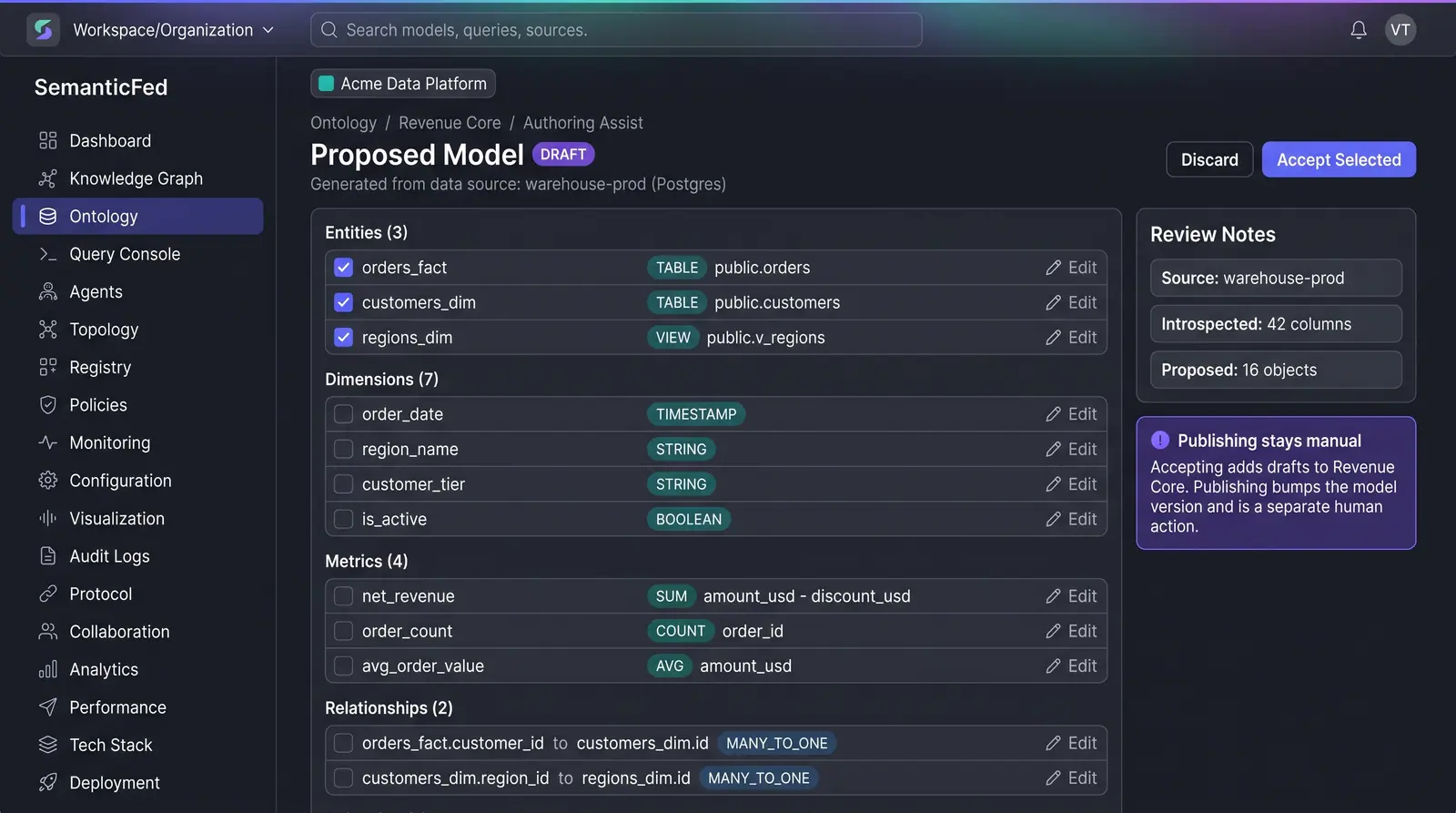
- AI & ML Engineers: Ground copilots and autonomous agents in a typed, access-controlled schema via MCP and GraphQL—using tools like AI-assisted model authoring[3] rather than exposing raw tables.
- Regulated Industries & Growing Teams: Query across distributed systems while keeping sensitive rows strictly inside compliance and data-residency boundaries.
 (opens in a new tab)
Illustration of the concept, not a screenshot of the actual product — AI-Assisted Model Authoring[3]
(opens in a new tab)
Illustration of the concept, not a screenshot of the actual product — AI-Assisted Model Authoring[3]
SemanticFed launches in 2026 and is currently in pre-launch. You can join the waitlist[4] for early access or discuss your data architecture on the contact page[5].
Sources
The pages this answer was drawn from.
- SemanticFed — Data Federation Platform for Data Teamssemanticfed.com(opens in a new tab)
- SemanticFed Features — Federated Query & Semantic Layersemanticfed.com(opens in a new tab)
- AI-Assisted Model Authoring — Concept | SemanticFedsemanticfed.com(opens in a new tab)
- Join Waitlist - SemanticFedsemanticfed.com(opens in a new tab)
- Contact Us - SemanticFedsemanticfed.com(opens in a new tab)