
AI-Assisted Model Authoring
Turn an introspected source schema into a proposed draft of entities, dimensions, metrics and relationships, then accept only what fits.
These images are illustrations of the concept, not screenshots of the actual product.
Overview
Semantic modeling is the work that makes a federated query worth trusting. Somebody has to decide which tables become entities, which columns are dimensions worth filtering on, how a metric like net revenue is actually calculated, and how the pieces join. Done by hand against a wide source schema, that is slow and easy to get subtly wrong. This concept shows the assisted path: a source is introspected, a complete draft model is proposed, and a modeler reviews it object by object instead of typing it from nothing.
The illustrated page sits under Ontology in the left navigation, with a breadcrumb running from the ontology through a model named in the sample data to an authoring assist step. The heading reads Proposed Model, carries a draft badge, and states that the proposal was generated from a registered database source. Discard and Accept Selected sit at the top right, which sets the tone for the whole screen: nothing here has entered the model yet.
The body groups the proposal the way the semantic layer is structured. An entities section lists the candidate objects with a badge marking each as a table or a view and the underlying object it maps to. A dimensions section lists candidate attributes with their types, spanning timestamp, string and boolean columns. A metrics section is the most opinionated part, pairing each proposed measure with its aggregation and expression, including a net revenue figure defined as a sum of an amount column minus a discount column. A relationships section proposes the joins between entities and labels their cardinality. Every row carries its own checkbox and an edit control, so a reviewer can accept some objects, correct others and leave the rest.
A side panel keeps the review honest. Review notes name the source, how many columns were introspected and how many objects the draft proposes, so the ratio between raw schema and modeled surface is visible. A second note states that publishing stays manual: accepting adds drafts to the model, while publishing bumps the model version as a separate human action. The accepted model is what queries plan against, what access policies attach to, and what agents read when they need governed context.
What this concept shows
- A proposed model presented as a draft, with Discard and Accept Selected rather than an automatic write
- Candidate entities labeled as tables or views alongside the source objects they map to
- Proposed dimensions listed with their data types, including timestamp, string and boolean attributes
- Proposed metrics shown with aggregation and expression, so a definition can be checked before acceptance
- Proposed relationships between entities with their cardinality labeled
- Per-row checkboxes and edit controls for accepting, amending or skipping each object individually
- Review notes naming the source, the number of columns introspected and the number of objects proposed
- A note separating acceptance from publishing, which bumps the model version as its own human step
How it works
- Open Ontology and start an authoring assist against a registered data source.
- Let the source schema be introspected and a complete draft model proposed.
- Review the proposed entities and confirm which tables and views belong in the model.
- Work through the dimensions and metrics, checking each aggregation and expression before selecting it.
- Check the proposed relationships and their cardinality so joins resolve the way the business expects.
- Edit any object that needs correcting, then accept the selected subset or discard the whole proposal.
- Publish separately when the draft is ready, which advances the model version.
Who it's for
- Analytics engineers
- Data modelers and semantic layer owners
- Data architects
- Analytics leads standardizing metric definitions
Illustrations
1 illustration of this concept. Select one to view it full size.
Proposed Model Awaiting Review
A desktop layout with the product's left navigation, a workspace and organization switcher and a global search field. Ontology is selected. A breadcrumb leads from the ontology through a sample model to an authoring assist step, under a heading that reads Proposed Model with a draft badge and a line naming the database source it was generated from. Discard and Accept Selected sit top right. Four grouped sections list the proposal: entities badged as tables or views with their source objects, dimensions with types such as timestamp, string and boolean, metrics paired with an aggregation and an expression, and relationships between entities with their cardinality. Every row has a checkbox and an edit control, and only the entity rows are checked in this sample state. A side panel shows review notes on the source, columns introspected and objects proposed, plus a note that publishing remains a separate human action.
Topics
- semantic model authoring
- schema introspection to ontology
- assisted data modeling
- entity dimension metric modeling
- metric definition review
- draft model approval workflow
- relationship cardinality modeling
- governed semantic layer
- model versioning and publishing
Related concepts
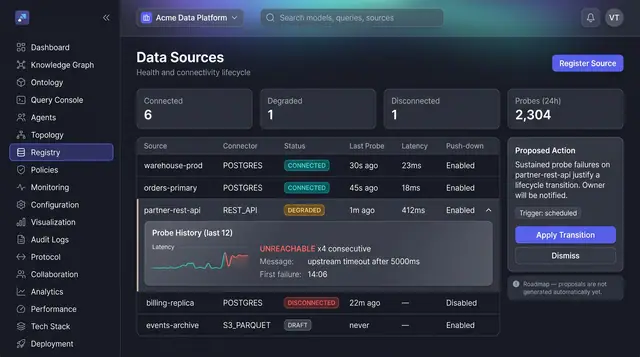
Source Health and Lifecycle Triage
See every registered source's health at a glance, open the probe history behind a failure, and act on a proposed lifecycle transition.
1 illustration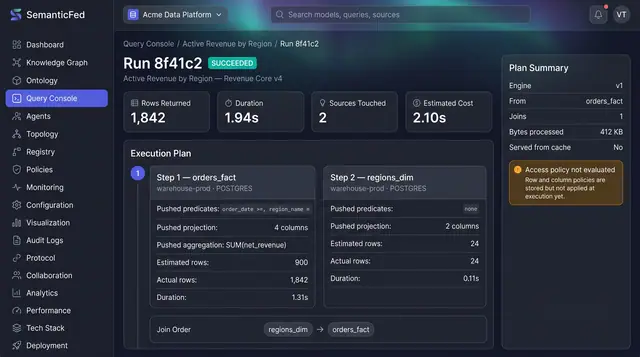
Federated Query Execution Plans
Open any query run and see exactly what was pushed down to each source, what each step really returned, and how the results were joined.
1 illustration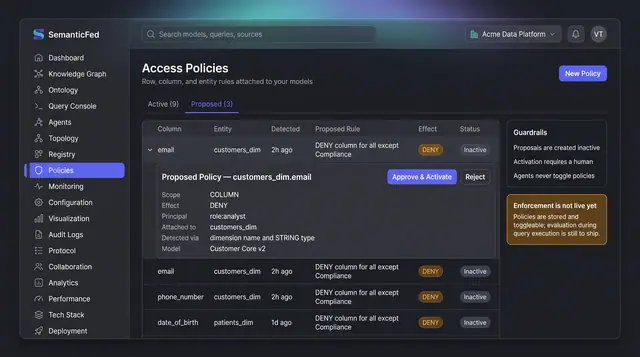
PII Access Policy Proposals
Sensitive columns are surfaced as inactive policy proposals with their detection reasoning, and only a person can approve and activate them.
1 illustration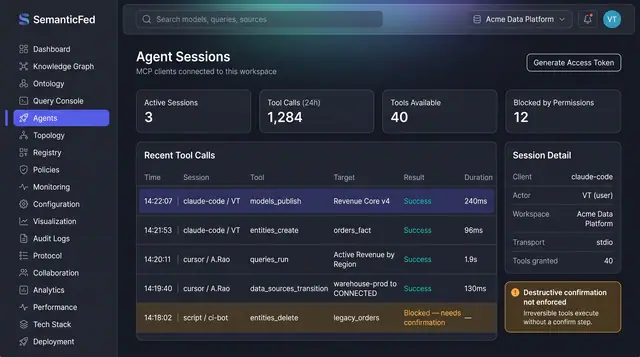
MCP Agent Sessions and Governance
Watch every tool call an AI agent makes in the workspace, and govern which tools agents may use through the same path people take.
2 illustrations