
How is SemanticFed different from Cube?
SemanticFed and Cube both provide governed semantic modeling, but they differ fundamentally in query architecture, source connectivity, and AI integration
About this answer — Produced by our own assistant on 23 September 2026 from our published documentation. The pages it drew on are linked under the answer. It is generated text, not a statement from a person — where it and a linked page disagree, the page is right.
Answer
SemanticFed[1] and Cube both provide governed semantic modeling, but they differ fundamentally in query architecture, source connectivity, and AI integration:
| Product | Query Execution | Source Coverage | AI Integration |
|---|---|---|---|
| SemanticFed[1] | In-place federated push-down engine | Direct DBs, lakes, warehouses & APIs | Native Model Context Protocol (MCP) server |
| Cube | Executes inside customer warehouse | Warehouse-centric (requires ETL) | Proprietary AI API & Analytics Chat |
Key differences:
- True Federation vs. Warehouse Reliance: SemanticFed[1] executes federated queries directly across operational databases, warehouses, lakes, and SaaS APIs without requiring ETL pipelines. Cube acts as a modeling layer where queries run inside the customer's cloud data warehouse.
- Cross-Source Edge Governance: SemanticFed defines and enforces access policies, row-level rules, and column masking directly at the federation layer rather than delegating security to individual storage engines.
- Open AI Agent Surface: SemanticFed exposes governed models, metrics, and tools via a native MCP server for agent workflows, as outlined in MCP Agent Sessions and Governance[2], whereas Cube relies on proprietary analytics interfaces.
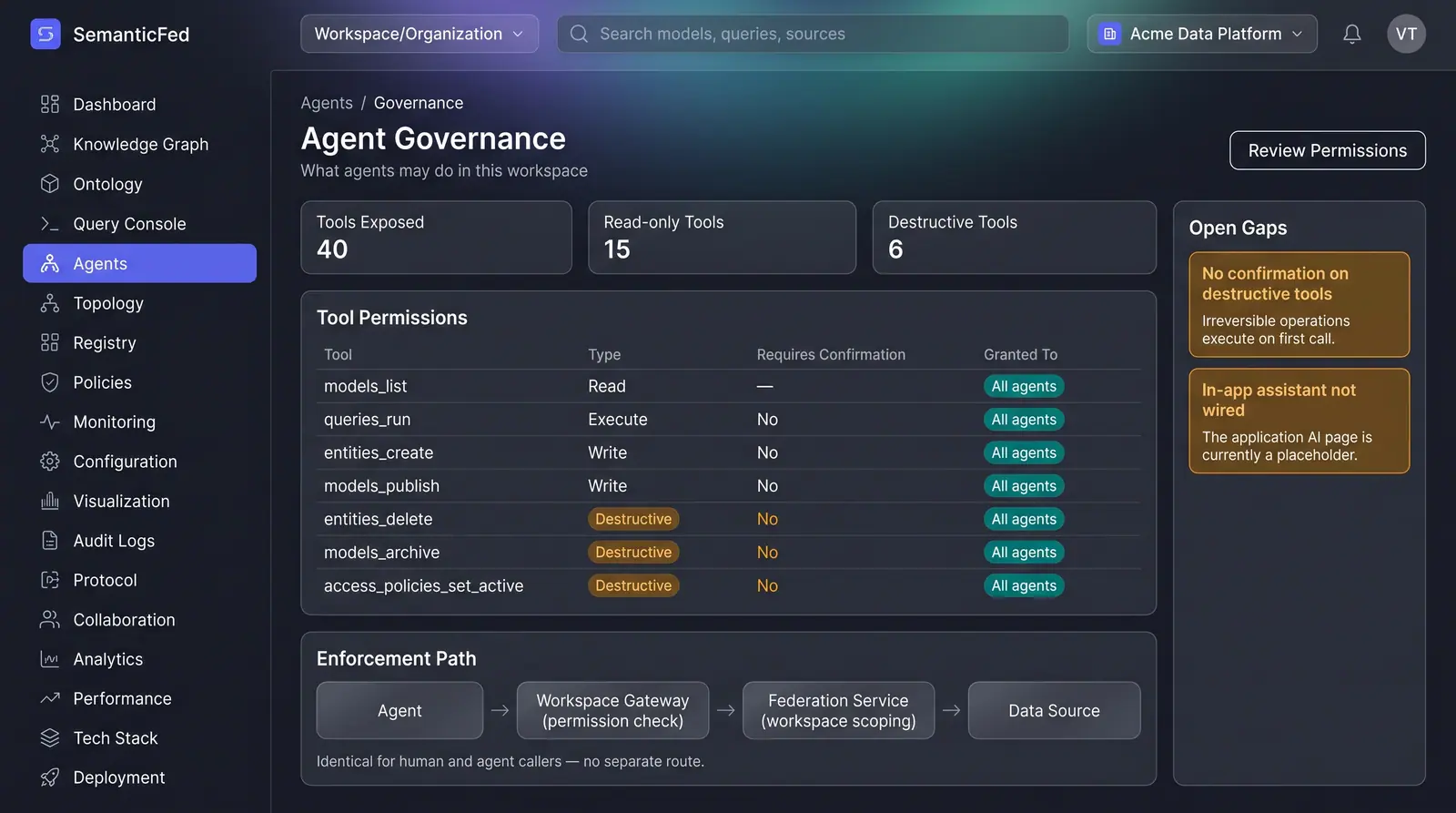 (opens in a new tab)
Illustration of the concept, not a screenshot of the actual product — MCP Agent Sessions and Governance[2]
(opens in a new tab)
Illustration of the concept, not a screenshot of the actual product — MCP Agent Sessions and Governance[2]
SemanticFed is pre-launch for 2026; visit the SemanticFed Pricing[3] page to join the waitlist for launch updates.
Sources
The pages this answer was drawn from.