
Won't federated queries be slow and run up my warehouse bill?
SemanticFed is designed to prevent latency bottlenecks and uncontrolled warehouse spend through push-down optimization, cost-aware planning, and configurable caching
About this answer — Produced by our own assistant on 23 September 2026 from our published documentation. The pages it drew on are linked under the answer. It is generated text, not a statement from a person — where it and a linked page disagree, the page is right.
Answer
SemanticFed[1] is designed to prevent latency bottlenecks and uncontrolled warehouse spend through push-down optimization, cost-aware planning, and configurable caching:
- Cost-Aware Push-Down Execution: Rather than pulling entire tables over the network, the query engine pushes predicates, projections, and aggregations directly down to each source database, lake, or warehouse. As highlighted on the SemanticFed features[2] page, the planner estimates execution costs to choose the path that moves the fewest bytes.
- Opt-In Caching & Materialization: On hot query paths that demand low latency, you can configure result caching with custom time-to-live (TTL) windows, ensuring that repeated dashboard requests do not trigger redundant compute against your warehouse.
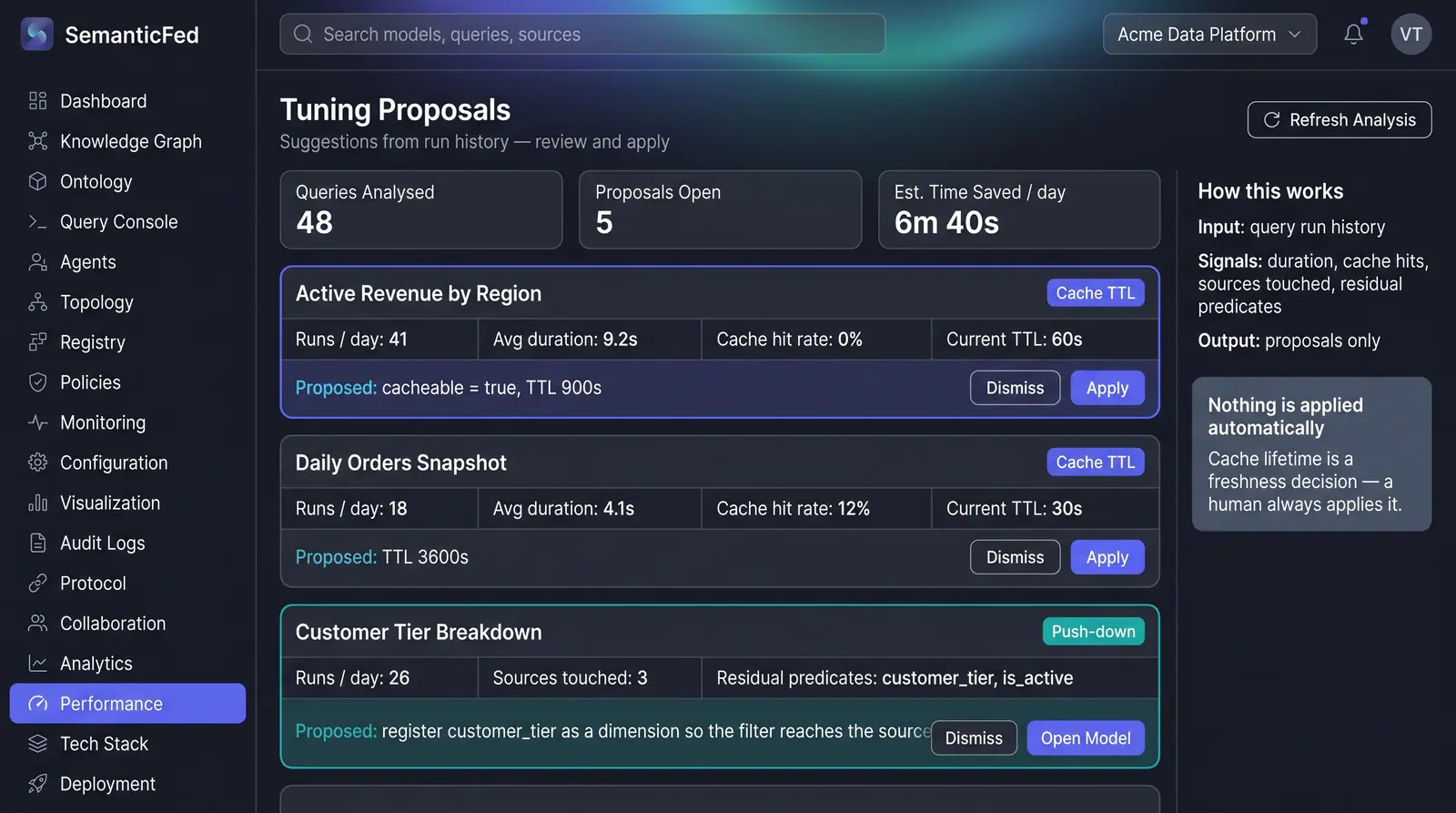
- Performance Tuning Proposals: SemanticFed analyzes query run history to detect un-cached queries and residual filters that were applied after rows arrived. The Cache and Push-Down Tuning Proposals[3] interface reviews these signals and suggests concrete optimizations, such as extending a cache window or registering a semantic dimension so filters push down to the source. You can also inspect execution details per run using Federated Query Execution Plans[4].
 (opens in a new tab)
Illustration of the concept, not a screenshot of the actual product — Cache and Push-Down Tuning Proposals[3]
(opens in a new tab)
Illustration of the concept, not a screenshot of the actual product — Cache and Push-Down Tuning Proposals[3]
To try federated querying across your data sources when access opens, sign up on the SemanticFed waitlist[5].
Sources
The pages this answer was drawn from.
- SemanticFed — Data Federation Platform for Data Teamssemanticfed.com(opens in a new tab)
- SemanticFed Features — Federated Query & Semantic Layersemanticfed.com(opens in a new tab)
- Cache and Push-Down Tuning Proposals — Concept | SemanticFedsemanticfed.com(opens in a new tab)
- Federated Query Execution Plans — Concept | SemanticFedsemanticfed.com(opens in a new tab)
- Join Waitlist - SemanticFedsemanticfed.com(opens in a new tab)