Data Access Request and Residency Review
Review each data access request with its purpose, fields, source region and proposed policy side by side, then grant it with an expiry.
These images are illustrations of the concept, not screenshots of the actual product.
Overview
In data and analytics organizations that hold customer data in more than one region, an access request is rarely a simple yes or no. This concept illustrates an access request queue in SemanticFed for data owners, data protection leads and platform teams, where each request is reviewed by its purpose and by where its data lives, and becomes a governed, time-limited grant rather than a standing permission.
A marketer in one country asks for a list of loyalty members held in another; a finance analyst asks for store labor hours. Granting the whole table is quick and usually more than the purpose needs, and when a source must stay in its region, a full extract may not be possible at all. Declining outright stalls the work. The concept is designed to propose the narrowest grant that serves the stated purpose, as an inactive access policy, and route it to whoever is responsible for that data.
The page sits under Policies, headed Access Requests and described as governed data reviewed by purpose and region, with pending, approved and expired tabs. The table lists each request with its requester, the data asked for, its source region, purpose, route and status. The sample rows cover a win-back audience routed to the data protection lead, a labor cost model and a margin review routed to data owners, the latter approved for ninety days, and a store clienteling request that was declined. The expanded win-back request lists the requested fields, with the consent field carrying a row rule of consent equals yes and the email field tagged as personal data that stays in the EU. The Proposed grant sets its scope as row plus column, allows counts across the region boundary while the member list stays in the EU, assigns the audience build to the EU marketing team, masks email and expires in thirty days. Decline and Approve and activate sit at the foot.
The proposed grant carries a chip showing it was routed by a FluidGrids rule set for EU personal data, and a Consoles using this grant line names a BigConsole win-back audience sizing console that reads counts only. The design intent is that a FluidGrids decision-rule workflow routes each request to the right approver and waits for the decision, SemanticFed activates the approved policy with its expiry and attributes every resulting query run in the audit trail, and BigConsole shows the approved figures without any personal records leaving the region. A Guardrails panel states that grants start inactive, that every run is audited and that rows stay in their source region.
What this concept shows
- Pending, approved and expired tabs, each with a count
- A request table showing requester, data, source region, purpose, approval route and status
- Region badges marking each source as EU only or US
- Requested fields listed one by one, with a consent row rule and a personal data tag that keeps email in the EU
- A proposed grant that allows counts across the region while the member list stays in the EU
- A masked email column, a named audience-building team and a thirty-day expiry on the grant
- A FluidGrids routing chip and a BigConsole sizing console that reads counts only
- Guardrails stating that grants start inactive, every run is audited and rows stay in their source region
How it works
- Open Access Requests under Policies and review the pending requests.
- Read each request's requester, data, source region, purpose and the approver it is routed to.
- Expand a request to see the requested fields and the rules attached to them.
- Check the proposed grant: its scope, its effect across the region boundary, its masking and its expiry.
- Approve and activate the grant, or decline the request.
- Check which consoles use the grant, such as a BigConsole win-back sizing console that reads counts only.
Who it's for
- Data owners
- Data protection leads
- Data platform engineers
- Analysts requesting governed data
Illustrations
1 illustration of this concept. Select one to view it full size.
Access Requests Reviewed by Purpose and Region
A desktop layout with Policies selected and a page headed Access Requests, described as governed data reviewed by purpose and region, with pending, approved and expired tabs. The table lists sample requests with requester, data, source region, purpose, route and status: a marketing win-back audience from an EU-only loyalty source routed to the data protection lead, a finance labor cost model awaiting a data owner, a merchandising margin review approved for ninety days and a stores clienteling request declined. The first request is expanded to its requested fields, with a consent row rule and an email field tagged as personal and staying in the EU. The Proposed grant lists row plus column scope, counts allowed across the region while the list stays in the EU, an EU marketing team audience build, masked email, a thirty-day expiry and a FluidGrids routing chip, with a BigConsole counts-only console beneath. Decline and Approve and activate sit at the foot, and a guardrails panel sits to the right of the table.
Topics
- data access request workflow
- data residency review
- purpose-based data access
- time-limited data access grant
- cross-region data access
- counts-only data sharing
- column masking for personal data
- consent-based row filter
- data access approval routing
- EU personal data residency
Related concepts
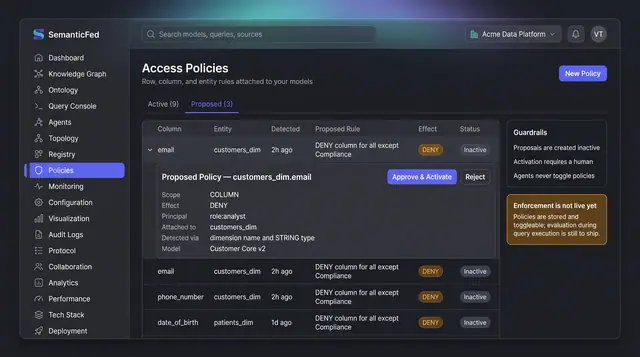
PII Access Policy Proposals
Sensitive columns are surfaced as inactive policy proposals with their detection reasoning, and only a person can approve and activate them.
1 illustration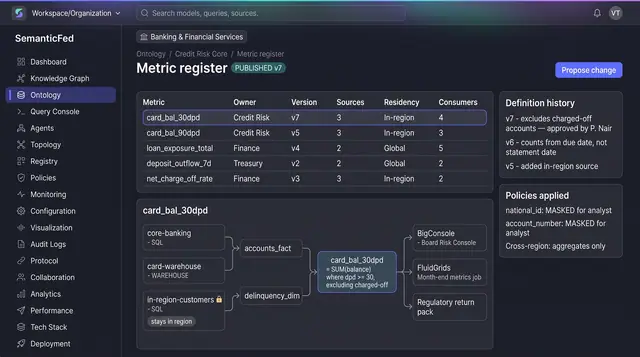
Regulatory Metric Lineage Register
Each regulatory and board metric defined once, with its version, source lineage, residency rule and every console that reads it.
1 illustration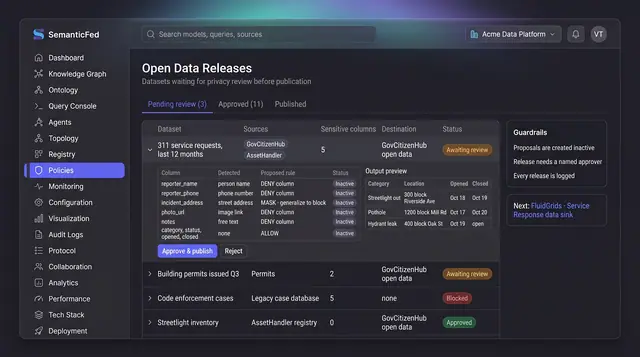
Open Data Release Privacy Review
Before a public dataset leaves the building, every column is checked for personal data and each deny or mask rule is approved by a person.
1 illustration
Part of an industry solution
This concept appears in a cross-product solution on burdenoff.com — see how it works alongside other Burdenoff products to solve a problem in that industry.