
Regulatory Metric Lineage Register
Each regulatory and board metric defined once, with its version, source lineage, residency rule and every console that reads it.
These images are illustrations of the concept, not screenshots of the actual product.
Overview
In banking and financial services, the same figure often appears in a board pack, a regulatory return and a risk console, and it is meant to be the same number in all three. This concept illustrates a metric register inside SemanticFed's governed model, where each regulatory and board metric has one definition, one owner and one version history, and where it can be traced back to the sources it reads and forward to everything that reads it.
Disagreement usually starts quietly. One team counts delinquency from the statement date and another from the due date; one includes charged-off accounts and another does not. Each is defensible alone, yet together they produce a board pack and a return that disagree. Regulated customer data adds a second constraint, since rows held in an in-region customer database may not leave that region. The design makes a change to a published metric a proposed, reviewed and versioned event instead of a silent edit.
The illustrated page sits under Ontology, inside a credit risk model, with a Banking & Financial Services chip, a published version badge on the Metric register heading and a Propose change action. The register table lists each metric with its owner, version, number of sources, residency and number of consumers; the sample rows cover card balances thirty and ninety days past due, total loan exposure, a seven-day deposit outflow and a net charge-off rate, owned by credit risk, finance and treasury. The selected thirty-days-past-due metric has its lineage drawn below: the core banking system and the card platform's warehouse feed an accounts fact, a locked in-region customer database feeds a delinquency dimension, and both lead to the metric, defined as the sum of balances thirty or more days past due, excluding charged-off accounts.
Beside the lineage, a definition history records why each of the last three versions changed: adding the in-region source, counting from the due date rather than the statement date, and excluding charged-off accounts, with a named approver on the latest. A Policies applied panel shows national identifiers and account numbers masked for analysts and a cross-region rule of aggregates only. Downstream, the lineage names a BigConsole board risk console, a FluidGrids month-end metrics job and the regulatory return pack. In the design, BigConsole presents the published figure to the board, the FluidGrids job feeds that console, and the owner sees every consumer before proposing a change. The same register pattern is designed to serve sustainability and ESG reporting teams, whose disclosed figures need the same single definition, change history and traceable sources.
What this concept shows
- A register table listing each metric's owner, version, source count, residency and consumer count
- A published version badge and a Propose change action for reviewed, versioned updates
- A lineage diagram tracing a metric from core banking, card warehouse and in-region customer sources through a fact and a dimension
- The metric definition stated plainly, such as balances thirty or more days past due excluding charged-off accounts
- An in-region source marked with a lock and a stays in region label
- A definition history giving the reason for each version change and who approved the latest one
- Policies masking national identifiers and account numbers for analysts, with aggregates only across regions
- Downstream consumers including a BigConsole board risk console, a FluidGrids month-end job and the regulatory return pack
How it works
- Open the metric register within a governed model under Ontology.
- Scan the metrics by owner, version, residency and number of consumers.
- Select a metric to trace its lineage from source systems through facts and dimensions to its definition.
- Read the definition history to see what changed in each version and why.
- Check the masking and cross-region policies applied to the metric's sources.
- Review the downstream consumers, then use Propose change to start a reviewed, versioned update.
Who it's for
- Risk and finance data owners
- Regulatory reporting teams
- Data governance leads
- Board reporting analysts
- Sustainability and ESG reporting leads
Illustrations
1 illustration of this concept. Select one to view it full size.
Metric Register With Lineage, History and Policies
A desktop layout with Ontology selected, a Banking & Financial Services chip, a breadcrumb into a credit risk model and a Metric register heading with a published version badge and a Propose change button. The register table lists sample metrics for card balances thirty and ninety days past due, total loan exposure, seven-day deposit outflow and net charge-off rate, with owner, version, source count, in-region or global residency and consumer count; the first row is selected. Its lineage panel links a core banking source and a card warehouse to an accounts fact and a locked in-region customer source to a delinquency dimension, both leading to the metric's formula, then out to a BigConsole board risk console, a FluidGrids month-end metrics job and a regulatory return pack. Side panels show a three-entry definition history and a Policies applied panel masking national identifiers and account numbers for analysts, with aggregates only across regions.
Topics
- regulatory metric lineage
- metric register for banks
- single definition of a metric
- board pack reconciliation
- days past due metric definition
- data residency for bank data
- metric version history
- data lineage for regulatory reporting
- governed semantic layer for finance
- ESG metric lineage
Related concepts
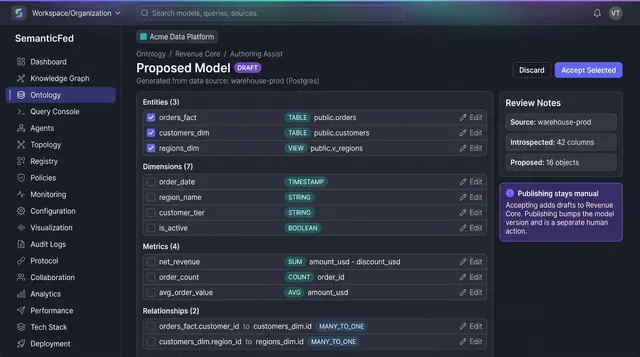
AI-Assisted Model Authoring
Turn an introspected source schema into a proposed draft of entities, dimensions, metrics and relationships, then accept only what fits.
1 illustration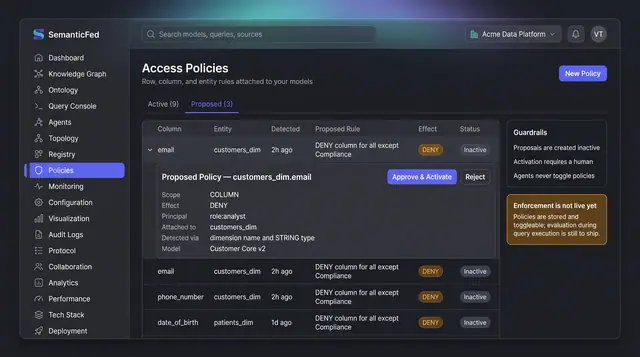
PII Access Policy Proposals
Sensitive columns are surfaced as inactive policy proposals with their detection reasoning, and only a person can approve and activate them.
1 illustration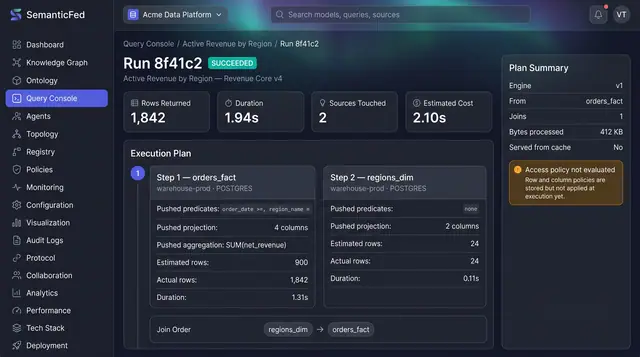
Federated Query Execution Plans
Open any query run and see exactly what was pushed down to each source, what each step really returned, and how the results were joined.
1 illustration
Part of industry solutions
This concept appears in cross-product solutions on burdenoff.com — see how it works alongside other Burdenoff products to solve a problem in that industry.

Industry solution
Banking & Financial Services
Shows one governed definition of each regulatory metric with its version history, source lineage, residency rule and the consoles and jobs that read it.
See the solution(opens in a new tab)
Industry solution
Sustainability & ESG
Is designed to define each disclosure metric once in a versioned model and trace it to its sources and to the report lines and consoles that use it.
See the solution(opens in a new tab)