Lateral-Hire Conflicts Federated Search
Search a lateral partner's disclosure list against current and legacy matter records in one governed query, without copying either.
These images are illustrations of the concept, not screenshots of the actual product.
Overview
When a law firm considers a lateral partner, the conflicts team has to check every client and adverse party the candidate discloses against the firm's own matters, including matters inherited through earlier mergers. This concept illustrates that check as a single federated search in SemanticFed, designed to run against the systems where the records are already kept rather than against a copy assembled for the occasion.
Law firms and legal teams rarely hold matter history in one place. Current matters sit in the firm's matter system, older ones in a database kept from a merger, and the candidate's disclosure list arrives as a separate file. Checking by hand means repeated exports and name-by-name lookups, and a plain name search misses a party that appears under an alias or as the parent of an adverse party. The design models the party once, with aliases and parent-subsidiary links, so each hit carries a clear reason.
The illustrated run sits in the Query Console, titled as a lateral conflicts search for a sample litigation partner and marked succeeded. Summary cards count parties searched, sources touched, hits and hits sent for review. A Hits by source table lists each disclosed party, the candidate's role as represented or adverse, the matched firm record, the source and the match basis, with a status of needs review, informational or not sent. In the sample, one party matches as the parent of an adverse party, another is an exact-name current client, a third is an alias of a client, and the legacy matters from a merger surface a former client and a name-only similarity that is not sent. A Plan summary panel shows filters pushed down to both matter sources, the disclosure list read from object storage as Parquet, the party entity model with aliases and parent links, and that the result was not served from cache.
In the design, SemanticFed does not rank the hits. A send action is designed to pass the ones needing review to a ProServiceWorld conflict check, whose triage ranks them for the analyst, and a linked check sits beside the button in a pending state. A highlighted access policy note shows the design keeping disclosure lists visible to the conflicts team only. The same search is designed to run again at new-matter intake against all three sources, and the design copies nothing into a new store along the way.
What this concept shows
- Summary cards for parties searched, sources touched, hits and hits sent for review
- A hits table with disclosed party, the candidate's role, matched firm record, source, match basis and status
- Match basis labels for exact name, alias, parent link and name only
- Current matters and legacy merger matters searched together in one run
- Status badges separating hits that need review from informational hits and hits not sent
- A plan summary showing pushed-down filters, a Parquet disclosure list in object storage and the party model version
- A send action and a linked ProServiceWorld conflict check, whose triage is designed to rank the hits
- An access policy note restricting disclosure lists to the conflicts team
How it works
- Register current matter records and the legacy merger database as sources.
- Load the candidate's disclosure list into object storage as Parquet.
- Model the party once, with aliases and parent-subsidiary links.
- Run the lateral conflicts search from the Query Console.
- Review hits by source and match basis, and check the plan summary for how each source was read.
- Send the hits that need review to a ProServiceWorld conflict check for ranking and triage.
Who it's for
- Conflicts analysts
- Law firm risk and general counsel teams
- Lateral hiring partners
- Legal operations and data teams
Illustrations
1 illustration of this concept. Select one to view it full size.
Lateral Conflicts Run With Hits by Source
A desktop layout with the Query Console selected and a breadcrumb leading to a single run of a lateral conflicts search for a sample litigation partner, marked succeeded. Four cards count parties searched, sources touched, hits and hits sent for review. The Hits by source table shows sample disclosed parties, the candidate's role as represented or adverse, the matched firm record, the source as current matters or legacy matters from a merger, and a match basis of parent link, exact name, alias or name only. Status badges read needs review, informational or not sent. At the foot, a button sends three hits to ProServiceWorld, a note says they are ranked in its triage and a chip shows a linked conflict check as pending. A Plan summary lists pushed-down filters, the Parquet disclosure list, the party model with aliases and parent links, no cache use and an access policy note.
Topics
- lateral hire conflicts check
- law firm conflict search
- conflicts of interest check
- legacy matter database search
- alias and parent company matching
- disclosure list conflict screening
- federated search for law firms
- new matter intake conflicts
- legal data governance
Related concepts
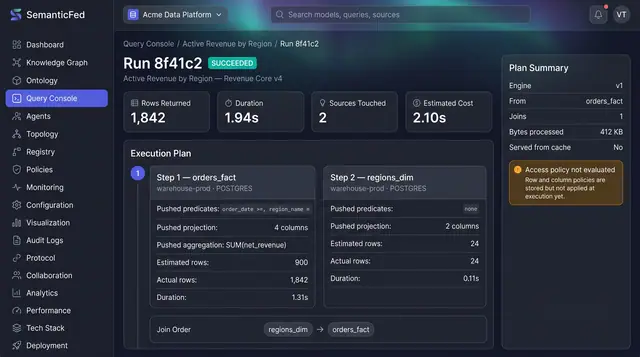
Federated Query Execution Plans
Open any query run and see exactly what was pushed down to each source, what each step really returned, and how the results were joined.
1 illustration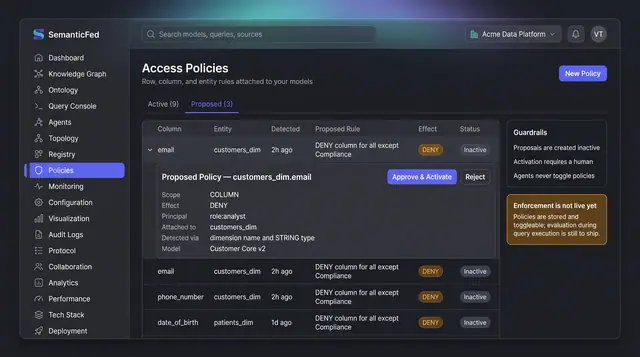
PII Access Policy Proposals
Sensitive columns are surfaced as inactive policy proposals with their detection reasoning, and only a person can approve and activate them.
1 illustration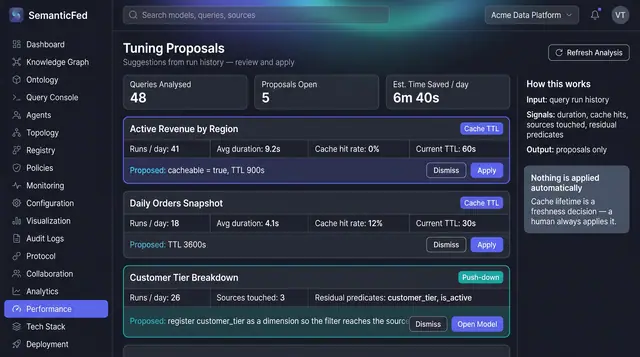
Cache and Push-Down Tuning Proposals
Read query run history back as concrete proposals: cache a query that never hits cache, or push a lingering filter down to the source.
1 illustration
Part of an industry solution
This concept appears in a cross-product solution on burdenoff.com — see how it works alongside other Burdenoff products to solve a problem in that industry.