Metric Definition Change Impact Review
Compare a proposed metric definition with the live one, see every console, query and agent that reads it, and how past values would move.
These images are illustrations of the concept, not screenshots of the actual product.
Overview
In data and analytics teams, a metric such as net sales is read by trading consoles, saved queries, scheduled loads and AI agents, so changing its definition is never a local edit. This concept illustrates the review step in SemanticFed that follows a proposed change. It is opened from Propose change in the metric register and covers the diff, the recompute and the sign-off before a new version is published, rather than acting as a second register.
Metric definitions change for good reasons. Finance may close the books on ship date while a dashboard counted order date, discounts, tax and shipping may be treated differently, and returns may be netted against one channel or another. Each fix can be correct, yet if it is published quietly, every console that reads the metric shifts at once and nobody can say why. The illustration follows a draft-to-published model lifecycle, in which publishing bumps the model version, and places the impact check between the published and draft versions.
The illustrated page sits under Ontology with a Data & Analytics chip, a breadcrumb into a sample retail model and a change review heading for net sales, with a published v3 badge and a draft v4 badge. The Definition diff sets the two expressions one above the other: v3 sums line amounts at order date with returns netted at the channel of return, while v4 subtracts discount, counts at ship date, excludes tax and shipping and nets returns at the channel of sale. A chart below recomputes the last eight weeks under both definitions, and a tooltip compares one week's sample values, so the size of the change is visible before anyone approves it.
A Consumers panel lists the six readers of the metric with their type, owner and impact: three BigConsole consoles with sample percentage shifts, one marked as adopting v4, a saved query, a FluidGrids nightly trading load marked to re-run after publish, and a Botlit Ask Data agent marked as citing v4. The design intent is that BigConsole presents the published figure, the FluidGrids workflow reloads the consoles it feeds once v4 is published, and the Botlit agent answers with the new definition and cites the version it used. An Approvals panel shows the metric owner approved and the analytics lead pending, with Request changes and Approve and publish v4 at the top. A change note shown on consoles is designed to travel with the metric, so each console can say what changed and when.
What this concept shows
- A change review opened from Propose change in the metric register, with published and draft version badges
- A definition diff stacking the published and draft expressions, covering date basis, exclusions and returns netting
- A chart recomputing the last eight weeks under both definitions, with a per-week tooltip
- A consumers table giving type, owner and impact for every console, saved query, workflow and agent that reads the metric
- Sample impact figures per BigConsole console, with one console marked as adopting the new version
- A FluidGrids workflow marked to re-run after publish and a Botlit agent marked to cite the new version
- An approvals panel for the metric owner and the analytics lead, with approved and pending states
- A change note field for the text shown on consoles, with Request changes and Approve and publish actions at the top
How it works
- Propose a change to a metric from the metric register, which opens the change review.
- Read the definition diff between the published version and the draft.
- Compare the last eight weeks recomputed under both definitions to see how far values move.
- Check every consumer of the metric, its owner and the expected impact.
- Collect sign-off from the metric owner and the analytics lead, or request changes.
- Write the change note, then approve and publish the new version, which consoles, workflows and agents are designed to pick up.
Who it's for
- Analytics engineers
- Metric owners
- Analytics leads
- Dashboard and console owners
Illustrations
1 illustration of this concept. Select one to view it full size.
Net Sales Change Review With Diff, Recompute and Consumers
A desktop layout with Ontology selected, a Data & Analytics chip and a breadcrumb into a sample retail model's net sales metric. The change review heading for net sales carries model, published v3 and draft v4 badges and a link back to Propose change in the metric register; Request changes and Approve and publish v4 sit top right. A Definition diff shows the v3 expression, at order date with returns netted at the channel of return, above the highlighted v4 expression, net of discount, at ship date, excluding tax and shipping. A chart plots the last eight weeks under both versions, with a tooltip comparing one week's sample values. A Consumers panel lists six readers: three BigConsole consoles and a saved query with sample percentage impacts, a FluidGrids workflow set to re-run after publish and a Botlit agent that will cite v4. Approvals show the metric owner approved and the analytics lead pending, and a change note says net sales now matches the finance close.
Topics
- metric definition change review
- semantic layer metric versioning
- metric change impact analysis
- net sales metric definition
- metric definition diff
- downstream dashboard impact
- recompute metric history
- metric governance approval
- metrics layer change management
- AI agent metric consistency
Related concepts
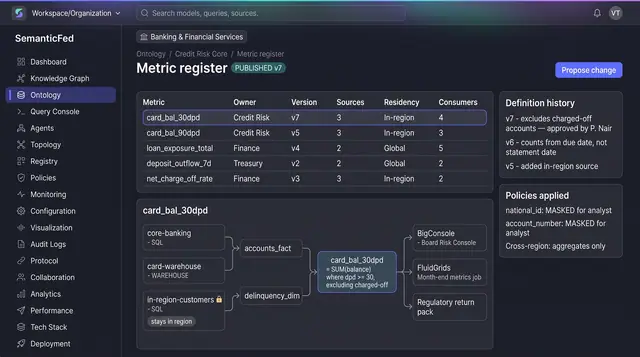
Regulatory Metric Lineage Register
Each regulatory and board metric defined once, with its version, source lineage, residency rule and every console that reads it.
1 illustration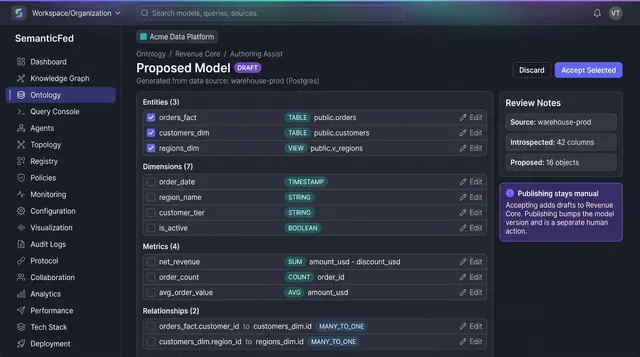
AI-Assisted Model Authoring
Turn an introspected source schema into a proposed draft of entities, dimensions, metrics and relationships, then accept only what fits.
1 illustration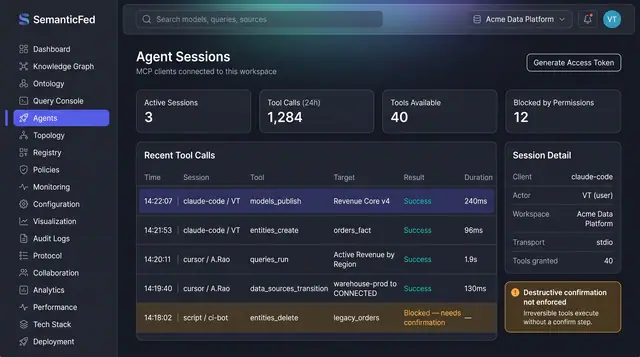
MCP Agent Sessions and Governance
Watch every tool call an AI agent makes in the workspace, and govern which tools agents may use through the same path people take.
2 illustrations
Part of an industry solution
This concept appears in a cross-product solution on burdenoff.com — see how it works alongside other Burdenoff products to solve a problem in that industry.