Genomic Consent-Scoped Data Access Review
Check each access request against participants' consent, see how many are eligible, and open nothing until the committee approves.
These images are illustrations of the concept, not screenshots of the actual product.
Overview
In biotechnology and genomics, a population cohort is often assembled from several hospital partners, and each participant's consent says what their data may be used for. This concept illustrates a data access committee view in SemanticFed where every request for cohort data is checked against that consent before anything is opened. The page sits under Policies, headed Data Access Requests and described as a population cohort whose consent is read where each hospital keeps it.
Consent is not uniform. Participants enrolled under different consent versions agreed to different things, some ruling out commercial use and others limiting it to one disease area, and some have since withdrawn. A committee weighing a partner's request for variant frequencies needs to know how many participants the request can actually reach, and a copied consent spreadsheet goes stale the day a withdrawal arrives. The concept is designed to resolve each request's stated use against the consent codes in each hospital partner's own register, or the consent extract it shares, rather than against a central copy.
Tabs separate requests pending review, approved and expired, with counts on the first two. The request table lists each request with its requester, stated use, eligible participants out of the whole cohort and a status; the sample rows show a pharma partner's commercial cardiometabolic target validation and a university group's academic disease research, both awaiting the committee. Expanding the first request opens Eligibility by consent version, giving each version's scope and participant count, marked included or excluded, with withdrawn participants in their own excluded group. Beside it, a Proposed policy pairs a row rule that allows only participants whose consent permits commercial use in this disease area with a column rule denying date of birth and hospital number, names the partner analyst role it would apply to, carries an end date and shows as inactive. Approve & activate and Reject sit beneath.
A Withdrawals this week panel shows how the design handles a change of mind. A withdrawal recorded by a hospital is designed to drop out of the eligible rows on the next request, and the sample withdrawal carries three markers: routed by FluidGrids as a consent withdrawal, flagged in two earlier releases, and a LabsOfScience sample hold placed. The design intent is that a FluidGrids workflow routes each withdrawal notice to the committee, flags the earlier releases that included the participant and requests a sample hold in LabsOfScience, while SemanticFed governs which rows any approved policy can reach. A Guardrails panel states that policies are created inactive, that approval needs a named committee member and that every decision is logged.
What this concept shows
- Pending review, approved and expired tabs, with counts on the first two
- A request table with requester, stated use, eligible participants out of the cohort and status
- Eligibility by consent version, showing each version's scope, participant count and whether it is included
- Withdrawn participants listed as their own group and left out of the eligible count
- A proposed policy pairing a consent-scoped row rule with column denials for date of birth and hospital number
- A named principal role, an end date and an inactive badge on the proposed policy while it awaits committee approval
- A withdrawals panel showing a FluidGrids-routed notice, earlier releases flagged and a LabsOfScience sample hold
- Guardrails stating that approval needs a named committee member and that every decision is logged
How it works
- Open Data Access Requests under Policies and review the requests pending committee review.
- Read each request's requester, stated use and how many cohort participants are eligible.
- Expand a request to see eligibility broken down by consent version, with withdrawn participants excluded.
- Check the proposed policy: the row rule by consent scope, the denied identifier columns, the role it applies to and its end date.
- Approve & activate the policy as a named committee member, or reject the request.
- Check the Withdrawals this week panel, where each notice routed by FluidGrids shows the earlier releases flagged and any LabsOfScience sample hold placed.
Who it's for
- Data access committee members
- Genomic cohort data managers
- Hospital research data stewards
- Biobank and sample managers
Illustrations
1 illustration of this concept. Select one to view it full size.
Cohort Access Requests Checked Against Consent
A desktop layout with Policies selected in the left navigation and a page headed Data Access Requests, described as a population cohort with consent read where each hospital keeps it. Tabs show pending review, approved and expired requests. The table lists request, requester, stated use, eligible participants and status; a sample pharma partner's request for variant frequencies across three targets, for commercial cardiometabolic target validation, is expanded. Eligibility by consent version lists four groups with scope, participant count and an included or excluded tag, with the no-commercial version and the withdrawn group excluded. A Proposed policy panel shows a row rule allowing commercial use in this disease area, a column rule denying date of birth and hospital number, a partner analyst principal, an end date and an inactive badge, above Approve & activate and Reject. A second, academic request sits collapsed below. On the right, a withdrawals panel shows FluidGrids routing, two releases flagged and a LabsOfScience sample hold, above a guardrails panel.
Topics
- genomic data access committee
- consent-based data access
- consent version eligibility
- genomic cohort data governance
- participant consent withdrawal
- consent codes for genomic data
- row level access by consent scope
- commercial use consent restriction
- biobank data access review
Related concepts
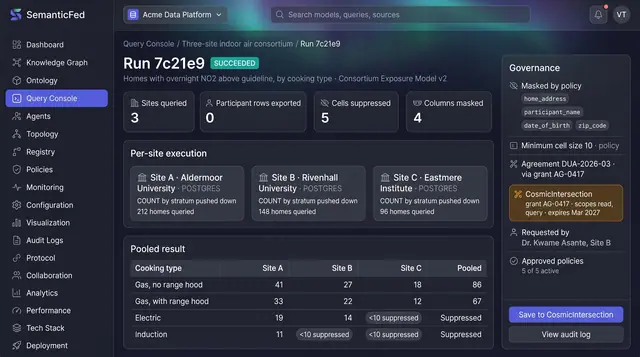
Research Consortium Federated Cohort Query
Answer a consortium question across every partner site's data in place, with participant fields masked and small counts suppressed.
1 illustration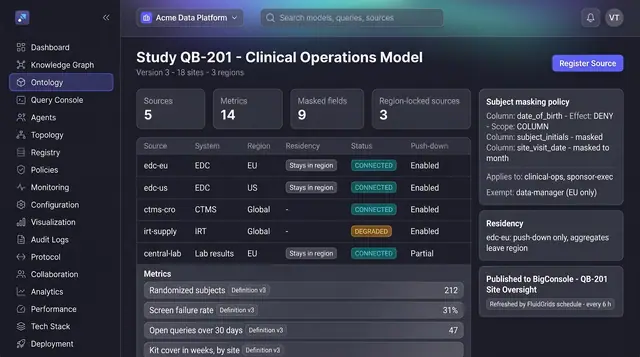
Clinical Trial Data Federation and Subject Masking
A governed model of a study across EDC, CTMS, IRT and central lab, keeping subject rows in region and masking re-identifying fields by role.
1 illustration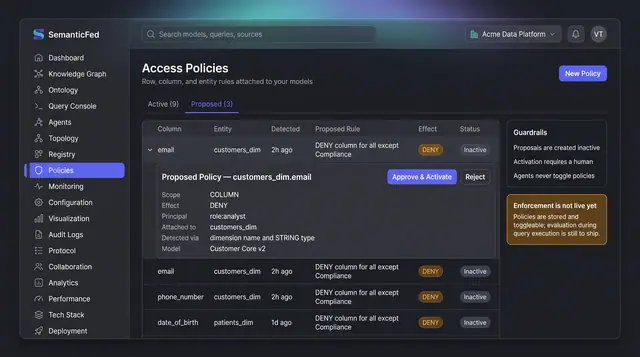
PII Access Policy Proposals
Sensitive columns are surfaced as inactive policy proposals with their detection reasoning, and only a person can approve and activate them.
1 illustration
Part of an industry solution
This concept appears in a cross-product solution on burdenoff.com — see how it works alongside other Burdenoff products to solve a problem in that industry.