Clinical Trial Data Federation and Subject Masking
A governed model of a study across EDC, CTMS, IRT and central lab, keeping subject rows in region and masking re-identifying fields by role.
These images are illustrations of the concept, not screenshots of the actual product.
Overview
In pharma, biotech and the wider life sciences, one clinical study runs on several systems at once. Electronic data capture holds the case report forms, a trial management system, often run by the contract research organization, tracks sites and visits, an interactive response system handles randomization and drug supply, and a central lab returns results. This concept illustrates SemanticFed modeling one study across all of them, so clinical operations, data management and privacy teams can work from one set of numbers without moving subject-level data anywhere it should not go.
Each of those systems counts in its own way, and the subject rows they hold are often bound to the region where they were collected. Reconciling figures such as randomized subjects or screen failures usually means exporting data, which creates new copies of fields like date of birth, initials or visit dates that could re-identify a participant. The design answers both problems inside the model: shared definitions are written once, queries are designed to be pushed down to each source, and column policies decide which roles see which fields.
The illustrated page sits under Ontology and is headed by a sample study's clinical operations model, with its version, site count and region count, beside a Register Source action. Summary cards count sources, metrics, masked fields and region-locked sources. A source table lists each system with its type, region, a Stays in region badge where residency applies, a connection status and a push-down setting. In the sample, both data capture instances and the lab are held in region, the randomization and supply system shows as degraded, and the lab's push-down is set to partial. Below, a Metrics list shows randomized subjects, screen failure rate, open queries over 30 days and kit cover in weeks by site, each tagged with its definition version.
On the right, a subject masking policy denies date of birth at column scope, masks subject initials and masks site visit dates to the month. It applies to clinical operations and sponsor executive roles, with data managers exempt in the EU only. A residency note marks the EU data capture source as push-down only, with aggregates leaving the region. The last panel shows the model published to a BigConsole site oversight console for the study, refreshed on a FluidGrids schedule every six hours. The design intent is a clear division of work: SemanticFed owns the definitions, residency and masking, FluidGrids is designed to run the refresh, and BigConsole is designed to receive only approved site-level aggregates for study oversight.
What this concept shows
- Summary cards counting sources, governed metrics, masked fields and region-locked sources for one study
- A source table covering data capture, trial management, randomization and supply, and central lab systems
- Stays in region badges and per-source push-down settings, including partial push-down for the lab
- Connection status per source, with a degraded randomization and supply system beside connected ones
- Shared study metrics such as randomized subjects, screen failure rate and open queries over 30 days, each tagged with its definition version
- A subject masking policy that denies date of birth, masks initials and masks visit dates to the month for named roles
- A residency note marking the EU data capture source as push-down only, with aggregates leaving the region
- A publication panel naming a BigConsole site oversight console, refreshed on a FluidGrids schedule every six hours
How it works
- Register each study system as a source, from data capture and trial management to randomization and the central lab.
- Mark the sources that must stay in region and set how far each one supports push-down.
- Define shared study metrics once, such as randomized subjects and open queries over 30 days, and version the definitions.
- Attach a subject masking policy that denies or masks re-identifying columns for the roles that do not need them.
- Check source status and residency rules before relying on the numbers.
- Publish approved site-level metrics to a BigConsole site oversight console, refreshed on a FluidGrids schedule.
Who it's for
- Clinical operations leads
- Clinical data managers
- Data privacy officers
- Sponsor and CRO study teams
Illustrations
1 illustration of this concept. Select one to view it full size.
Study Model With Region-Locked Sources and Subject Masking
A desktop layout with Ontology selected in the left navigation and a page headed by a sample study's clinical operations model, its version, site count and region count, beside a Register Source button. Four cards count sources, metrics, masked fields and region-locked sources. The source table lists two data capture instances, a trial management system, a randomization and supply system and a central lab, with regions, Stays in region badges where they apply, status badges that mark one source as degraded, and push-down set to enabled or partial. A Metrics list shows randomized subjects, screen failure rate, open queries over 30 days and kit cover by site, each marked with its definition version. Side panels show the subject masking policy with its roles and one exemption, a residency note marking the EU data capture source as push-down only with aggregates leaving the region, and publication to a BigConsole site oversight console on a six-hour FluidGrids schedule.
Topics
- clinical trial data federation
- EDC CTMS IRT data integration
- clinical subject data masking
- clinical data residency
- semantic layer for clinical studies
- screen failure rate reporting
- open query aging metric
- de-identifying clinical trial data
- sponsor and CRO data governance
- clinical trial site oversight metrics
Related concepts
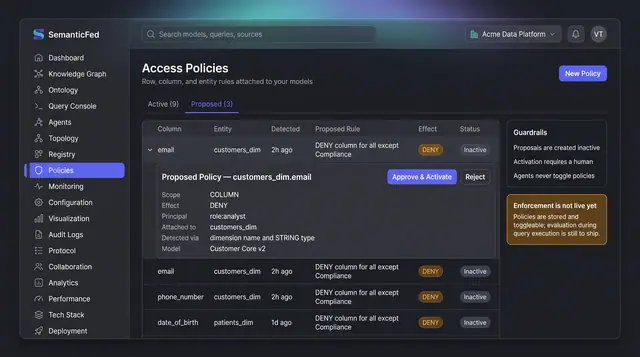
PII Access Policy Proposals
Sensitive columns are surfaced as inactive policy proposals with their detection reasoning, and only a person can approve and activate them.
1 illustration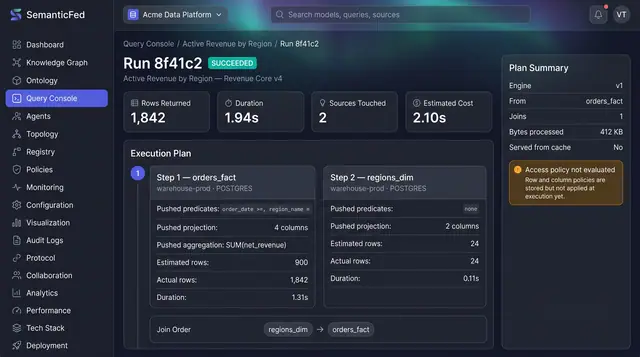
Federated Query Execution Plans
Open any query run and see exactly what was pushed down to each source, what each step really returned, and how the results were joined.
1 illustration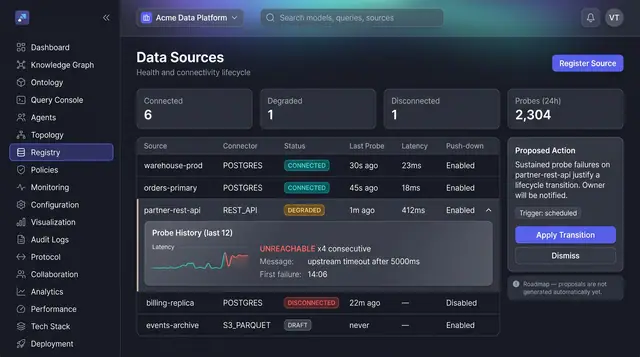
Source Health and Lifecycle Triage
See every registered source's health at a glance, open the probe history behind a failure, and act on a proposed lifecycle transition.
1 illustration
Part of an industry solution
This concept appears in a cross-product solution on burdenoff.com — see how it works alongside other Burdenoff products to solve a problem in that industry.